 The Average Learner
If we are prisoners of our own minds, we have to remember we are also our jailers.
Recently, I’ve finished this book called Act Before You overThink by Lison Mage. So this article would be a blend of personal findings and knowledge from this book.
Arguably, this is the only book you need to make a better decision. It helps me clears my bad thinking habit, such as too much analytical thinking on the “what ifs”. The writer also points out that what we need is not the best decision, but a good enough decision for the moment. As our goal should be trying to be better, not to be good. That’s because we can’t control the outcome, but we can control the process.
We should, however, aim for improving ourselves to get better at making decisions. It can mean a proper decision-making system, practices and certain level of “instinct” to achieve it.
Being an overthinker myself, I certainly know my thinking habits. “I have to make the best possible decision, otherwise I will regret it.” I would end up spending a tremendous amount of time trying to make that perfect decision. - A decision that could make me regret less, cost me less, and do less, yet has the biggest impact. Nevertheless, this is a fallacy for trying to control what we cannot. There is no such thing as a decision you don’t regret. It’s about how much you might regret it if it went wrong, and whether it is reversible.
This book, perfectly explained the flaws in such thinking logic, and how it leads to a result opposite to what we wanted. And of course, she has given us solutions through workable steps.
If you have heard this phrase: “You think too much.” in your life multiple times, read on, I guarantee you will take away a lot from this article.
The following is my digested learnings. It certainly does not include everything from the book. Therefore, it is suggested that you do check out the book Act Before You overThink by Lison Mage. Let’s continue on.
Identifying the problems
Perfectionism
In one form or another, what kept us thinking endlessly is that we try to find the best solution. The “what-ifs”. As if we can’t just stop at the first solution and be settled with. There has to be a better way. A strong belief of spending the more time on researching, thinking, exploring and evaluating can lead to the better decision we could make.
FOMO - Fear Of Missing Out
So you made a decision. A decision of choosing something or someone over the other. In other words, you are saying yes to option A and saying no to option B at the same time. But, what if both options are equally attractive? A coin flip situation? A decision can be hard to make because it is not as simple as we want one of them more, but it also means giving up on the other ones. Sometimes, we just don’t want to let go of the possibilities.
Sunk cost fallacy
Final year law students are in too deep to quit their law study just to become a plumber. All the effort and money spent are what causing them to narrow their paths. In such cases, sunk cost fallacy is at play to limit your options, or should I say vision, really.
Self narratives
We told ourselves we are not that kind of person. We can’t do this. I know I would prefer a certain method. But the truth is, everyone is limitless. “We don’t see things as they are, we see things as we are.”. If we pre-define ourselves, we would have been limiting our own options. “If we are prisoners of our own minds, we have to remember we are also our jailers.” So, keep ourselves open-minded.
Redefine the decision-making perspective
Reversibility - The importance of a decision
It’s not about choosing A over B, therefore you lose B. It’s about how reversible the decision of choosing A is.
To find out how important a decision is to you, don’t think about what it might bring you in the future. Instead, try to evaluate how hard it is to reverse the decision. In other words, the cost of undoing your decision. It could be time cost, money cost and relationship cost, etc. See if you can accept such costs. And, to what extent can you accept the loss. If you are able to undo the decision, the decision might not be such a big deal to you in the first place. Knowing this alone can ease your nerve and fasten the decision-making process a lot.
Value of Information
This is a piece in the maze we usually neglected. We overthink and over analysis by consuming information and assuming outcome. However, we usually do not evaluate the value of the information we introduced.
For example, you want to learn Japanese. So, you searched “How to learn Japanese” online. There are threads on Reddit and YouTube videos suggests you to read the book Genki, use Anki to learn vocabularies, and Bunpro app to learn grammar, etc. However, you usually didn’t stop there. You would continue to search if there’s any other books like Genki, any another app that’s cheaper than Bunpro, or more user-friendly app than Anki, etc. And, to even further distracting ourselves, what device do you read books on, etc.
For the example above, the value of information is decreasing the longer you do your searches. It is because the first few results already gave you the most value of how to learn Japanese. The follow-up in which books and apps are better, and which costs less, contains way less value than the first time you came across the related information.
It is not an easy task to properly value the information we come across. But, just to keep this in mind that we should focus on the big factors that could affect our decisions, not letting the small ones fuel our overthinking mind.
Focus on the process, not the outcome
Counter intuitively, we shouldn’t try to make a decision for the best outcome. Instead, make a decision base on how much we can control the process.
The book has given an example. There’s a cancer patient is in a serious condition, he might have just made it through himself, or he can perform a serious surgery. The catch is, there’s a 50% chance the patient would die from this surgery. Or if it turns out successful, he can live for another 10 years. And, it is your call to make the decision to perform the surgery or not.
It turns out that people who answered this question were happy with both decision, as long as the patient lives. On the other hand, regardless of the decision, if the patient died, they are regretful of their decision.
This thought experiment told us that we tend to focus on the outcome, not the process, even if it means it is uncontrollable. And this is exactly what we don’t want. We should take matters into our own hands. Control what we can instead of expecting the outcome would be a good one, it never works like that.
Value Filter
The last puzzle of making a better decision is your personal values.
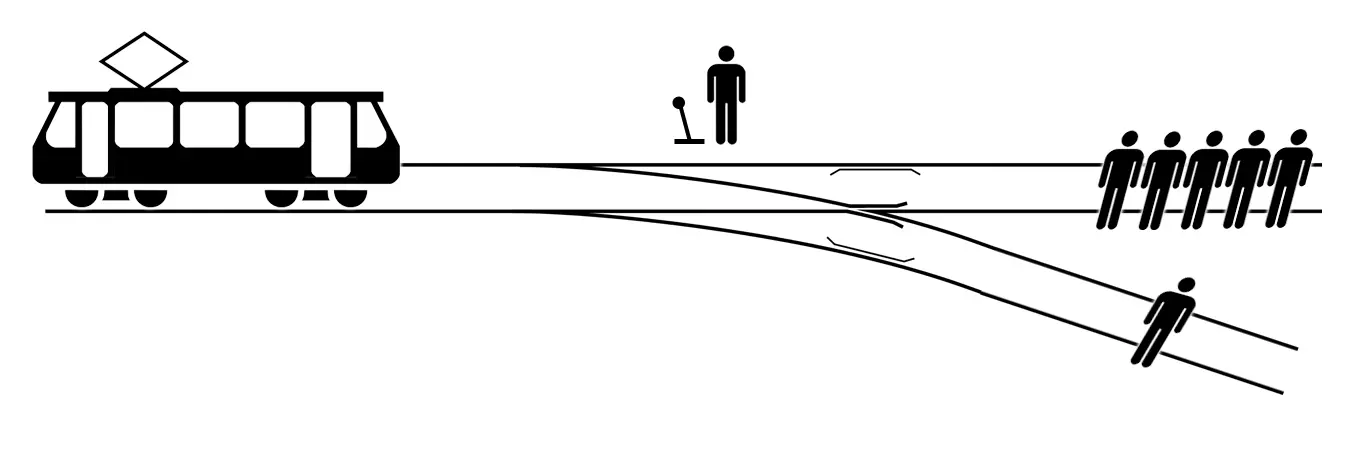
Accordingly to the book, The Cornelian dilemma, or better known as the trolley situation, is a good demonstration on how human make decisions based on their person value. The trolley situation, simply put, asks if you would pull the lever to change the train track for an unstoppable train. But, either you pull the lever or not, the train will kill a number of people who are on both A and B tracks. The catch is, if you pull the lever, only one human being will be killed, instead of five.
There are studies conducted regarding this situation, and people from different countries reacted totally differently. The point is that, when we simply cannot make a rational decision, we draw on our personal values to make decisions.
So, how should we make a decision?
Firstly, determine the importance of the decision you’re about to make by evaluating how reversible the decision is, what might cause you, and can you accept that. Then, consume just enough of high value information and to figure out how much we can control during the process. Finally, we can make the decision base on our personal value if there is no obvious winner.
Tricks and tips
Use the word “Yet” to replace “I could have”
By changing the narrative, it can rewire our brain to focus on what we can do and expect for the better future, than spending regretting what we did not do. So we can focus on process, not the outcome. Be better, not just good on the spot. No one can be good without a “be better” process.
Flip a coin
If you really cannot decide. Flip a coin. If you are not at ease with the result, it means you prefer the other one, you just don’t want to admit it yet.